
Cleaning and usage instructions for glass filter discs and glass filter apparatuses
Prime cleaning
Before using a glass filter apparatus for the first time, it should be cleaned from all dust and dirt particles. For that you use hot hydrochloric acid, followed by several steps of distilled water sucked through the filter disc.
Mechanical cleaning
Glass filter instruments should be cleaned immediately after use to extend the durability. If the pores of the filter disc are clean, it is sufficient to spray the surface with water and to clean it with a brush or a rubber wiper. If the pores are contaminated, back-flushing with water or rinsing solution is absolutely necessary. The pressure applied must not exceed 1 bar. After that a blowing through with pure air dries and cleans the filter disc additionally.
Chemical cleaning
If there are still clogged pores after a mechanical cleaning, a careful chemical cleaning is advisable. Depending on the contamination different solutions may have to be used. Afterwards the filter discs should carefully be rinsed with water.
Drying and sterilization
To prevent tensions between filter and vessel, you have to avoid temperature shocks, which can lead to breakages in the filter apparatus. Heating and cooling of glass filter instruments should be carried out slowly and evenly.
Pressure- and vacuum resistance
Pressure- and vacuum resistance cannot be guaranteed because of the material. Even the smallest damage of glass surface (like scratches) causes a loss of stability.
Temperature resistance
The maximum short-term operation temperature is 500 °C. Sudden temperature changes of glass filter instruments should be avoided. It is necessary to care about the designated heating and cooling rates for borosilicate glass 3.3 to avoid permanent tension in the glass.
Special notes
An increase in pore size is unavoidable with filtration of phosphoric acid, hydrofluoric acid and hot alkaline solutions. These solutions attack the glass surfaces and make them unsuitable as cleaning agents. Their usage decreases the durability of glass filter instruments considerably.
Porosity classes
Glass filters are divided into porosity classes from 0 to 5. Measurement of the porosity is carried out by a so-called bubble point process according to Bechthold. The following table provides an overview of porosity areas as well as their main fields of application. The specified pore size refers to the respective largest pore of a disc. Pore sizes mark also the minimum diameter of particles which can just be held back during filtration.
| Porosity | ISO 4793 | Nominal pore size | Application examples | |
|---|---|---|---|---|
 | 0 | P 250 | 160 – 250 µm | Gas distribution, filtration of coarse deposits, gas distribution in liquids |
 | 1 | P 160 | 100 – 160 µm | Filtration of coarse deposits, gas distribution in liquids, rough gas filtration, extractors for coarse materials, mats for filterlayers against gelatinous deposits |
 | 2 | P 100 | 40 – 100 µm | Preparative fine filtration, mercury filtration, preparative operations with crystalline deposits |
 | 3 | P 40 | 13 – 40 µm | Analytical filtration, preparative operations with fine deposits, filtration in cellulose chemistry, refined gas filtration, extraction instruments for fine-grained materials |
 | 4 | P 16 | 10 – 16 µm | Analytical presicion filtration and operations with very fine deposits, as check and stop valve for mercury |
 | 5 | P 1,6 | 1,0 – 1,6 µm | Filtration of bacteria, sterile filtration |
Influencing factors for flow rates and pressure drop
• Filter size
• Filter porosity
• Pressure/vacuum properties of the apparatus
• Physical properties of sample
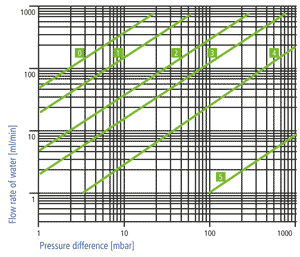
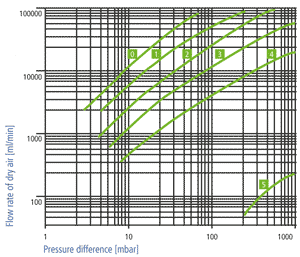
To choose the proper apparatus for the intended work, it is necessary to know the flow rates of liquids and gases. Please use the diagrams below which show data for water and air. The data apply to filter discs of 30 mm diameter with average properties and usually effective filter area and thickness, as well as pore sizes. The flow rates for other diameters can easily be calculated by multiplying this data by the conversion factor.
Conversion factors of flow rates
| Filter disc diameter (mm) | 10 | 20 | 30 | 40 | 50 | 60 | 90 | 120 | 175 |
| Conversion factors | 0,13 | 0,55 | 1,00 | 1,50 | 2,50 | 4,30 | 6,80 | 9,70 | 15,00 |